40I want to calculate my gauge
Convert between stitch counts, measurements, and pattern gauges
What is gauge? Gauge (also called tension) is the number of stitches and rows in a standard measurement — typically 10 cm (4″). Every knitter and crocheter works at a slightly different tension, so your gauge determines the final size of your project. A pattern that says “20 sts = 10cm on 4mm needles” is telling you the fabric density it was designed for.
Why does it matter? Even one stitch per 10cm off can add several centimetres to a sweater. If your gauge is tighter than the pattern, the piece comes out smaller; if it's looser, it comes out larger. The gauge calculator helps you measure, compare, and adjust before you commit to a full project.
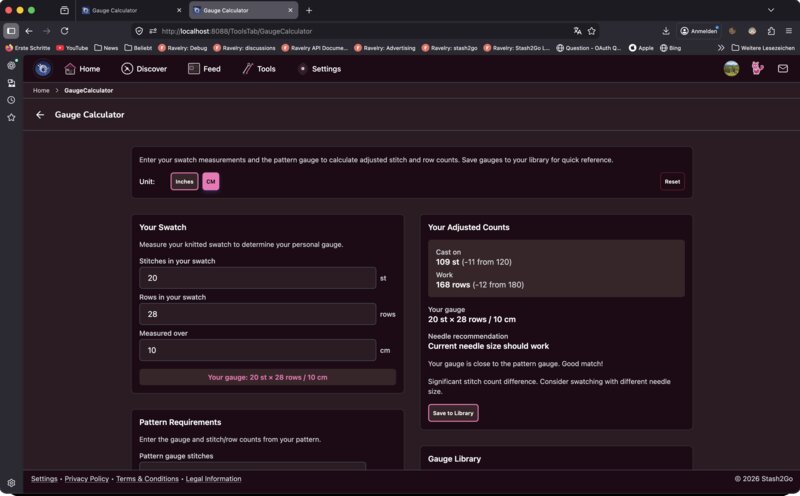
Navigate to Tools → Gauge Calculator. Enter how many stitches and rows you counted, and the width and height you measured over.
The calculator converts your raw count into a standardised gauge. For example:
- You counted
- 24 stitches over 12 cm
- Your gauge
- 20 sts / 10 cm
It does the same for rows, so you get both stitch gauge and row gauge in one step.
The result updates live as you type. No need to press a button — change any number and the gauge recalculates instantly.
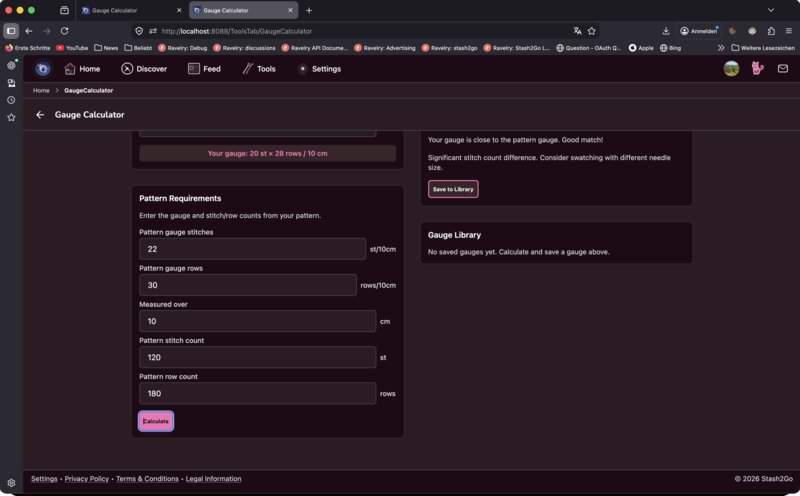
Enter the pattern's recommended gauge to see how yours compares. The calculator shows the difference and suggests needle size adjustments: go up a size if your gauge is too tight (too many stitches), or down if it's too loose (too few stitches).
Matching gauge exactly? You're good to go — cast on with confidence.
Off by half a stitch? Usually acceptable for most garments. Consider swatching once more to confirm.
Off by 1+ stitches? The finished piece will be noticeably different in size. Change your needle size and swatch again before starting the project.
Row gauge off but stitch gauge correct? This is common. Most patterns give length instructions in centimetres rather than row counts, so stitch gauge is usually more critical. Adjust row counts if the pattern relies on them.
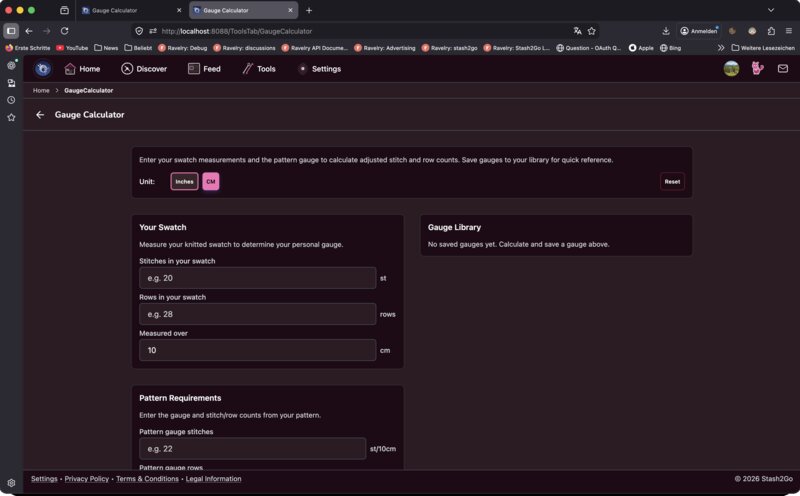
Switch between metric (stitches per 10 cm) and imperial (stitches per 4″) with a single tap. The calculator handles the conversion automatically, so you can work in whichever system your pattern uses.
Not sure if your gauge is in the right ballpark? Here are typical stitch gauges per 10 cm for common yarn weights:
- Lace
- 32–40 sts
- Fingering
- 28–32 sts
- Sport
- 24–28 sts
- DK
- 20–24 sts
- Worsted
- 16–20 sts
- Bulky
- 12–16 sts
- Super Bulky
- 8–12 sts
These are guidelines — every yarn, needle, and knitter combination is unique. Always swatch.
Available on iPhone, iPad, Android, and web at app.stash2go.com